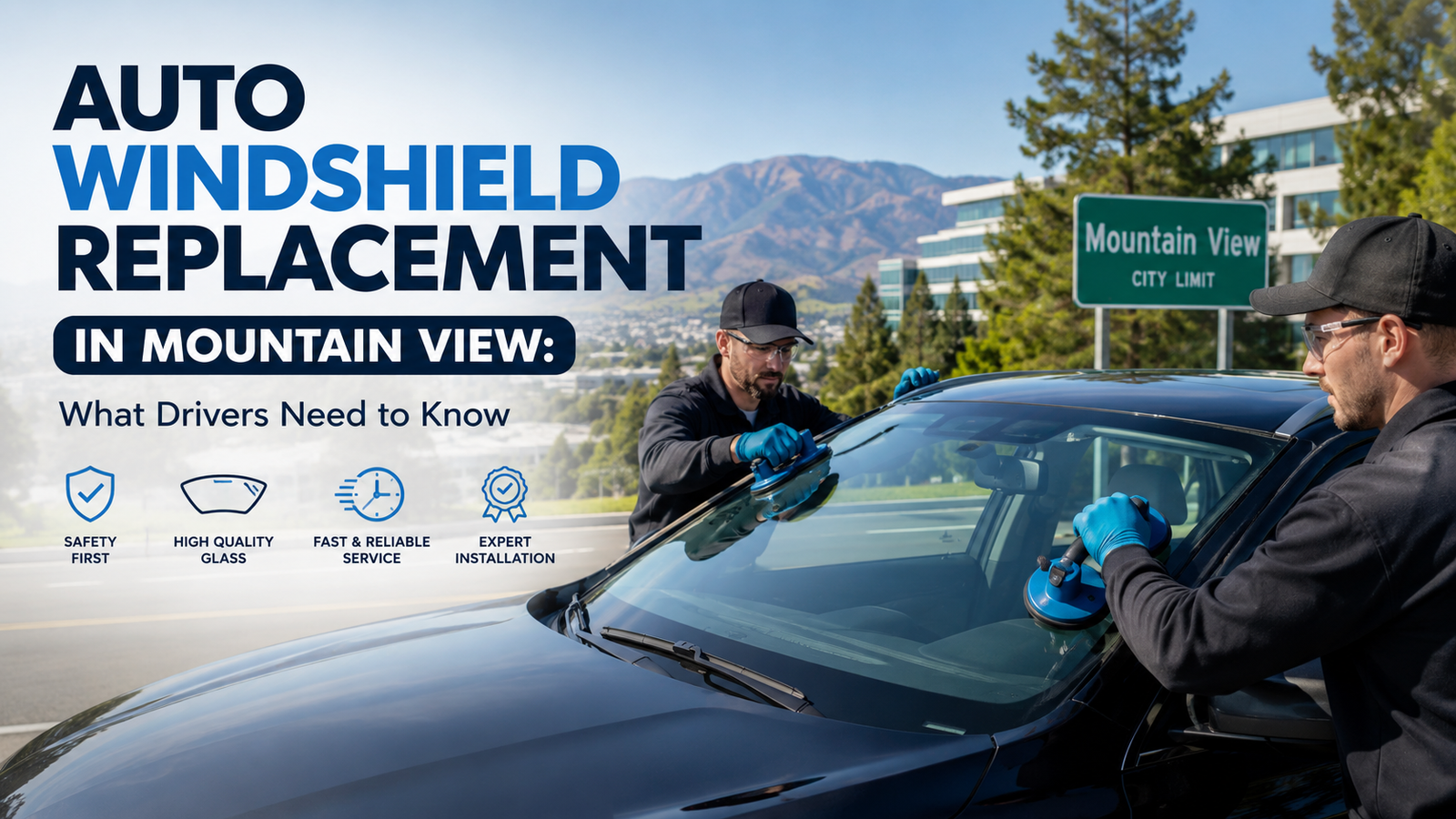
A cracked or damaged windshield is one of the most common vehicle issues drivers encounter in Mountain View and across the broader Bay Area. Whether the damage comes from a rock chip that spread overnight, a stress crack from temperature swings between cool coastal mornings and warm afternoon sun, or impact damage from freeway debris, the result is the same: a windshield that compromises visibility, structural integrity, and if left unaddressed may violate California vehicle code. Understanding what Auto Windshield Replacement Mountain View involves, when it’s necessary, and what to expect from the process helps Mountain View drivers make informed decisions when glass damage occurs.
Why Windshields Matter More Than Most Drivers Realize
Most drivers think of their windshield primarily as a window something to look through while driving. In modern vehicle design, however, the windshield serves critical structural and safety functions that go well beyond providing a view of the road. The windshield contributes significantly to the structural rigidity of the passenger compartment, particularly in rollover accidents where a properly bonded windshield prevents roof collapse. It also serves as the backstop for front-passenger airbag deployment in many vehicle designs the airbag inflates and rebounds off the windshield to properly cushion the front passenger. A poorly installed or compromised windshield can fail in both of these critical roles.
Modern vehicles increasingly integrate advanced driver assistance systems (ADAS) into the windshield mounting area, including cameras, lane departure warning sensors, rain sensors, heads-up display (HUD) projections, and automatic emergency braking sensors. These systems are calibrated to specific positions and angles relative to the windshield. When a windshield is replaced, proper ADAS recalibration is required to ensure these systems continue to function accurately. This is an important consideration for Mountain View drivers, where a significant proportion of vehicles given the region’s tech-savvy demographic and high rates of newer vehicle adoption feature one or more of these systems.
When Should a Windshield Be Repaired vs. Replaced?
Not all windshield damage requires full replacement. Chips and small cracks that meet certain criteria can often be repaired through a resin injection process that restores structural integrity and greatly improves appearance, typically in 30 minutes or less. The general guidelines that govern the repair-or-replace decision are based on the size, type, location, and depth of the damage.
Chips smaller than a quarter in diameter are generally repairable if they are not in the driver’s direct line of sight and do not extend through both layers of the laminated glass. Cracks shorter than about three inches may also be repairable, depending on their location and whether they have spread. Damage directly in the driver’s line of sight the critical viewing zone in front of the steering wheel often warrants replacement even if the damage itself would otherwise be repairable, because resin repairs leave a slight optical distortion that can be distracting in this zone.
Any damage that has spread across a significant portion of the windshield, has reached the edge of the glass (edge cracks are particularly prone to rapid spreading), penetrates through both plies of the laminated glass, or compromises areas where ADAS sensors are mounted typically warrants full replacement. Damage that has been present long enough to collect dirt, moisture, or road film is also more difficult to repair successfully and may be better addressed through replacement.
California law specifically prohibits driving a vehicle with a damaged windshield if the damage obstructs the driver’s clear view of the road or highway. Mountain View is served by both the California Highway Patrol and local traffic enforcement, and a cracked windshield that impairs visibility can result in a fix-it ticket. Prompt repair or replacement is both a safety imperative and a legal one.
The Windshield Replacement Process
A professional windshield replacement by a qualified auto glass technician follows a careful sequence designed to ensure both the quality of the installation and the safety of the finished result. The process begins with preparation removing interior trim pieces or moldings near the windshield, and cleaning the pinch weld (the flange of metal around the windshield opening) of old adhesive and debris.
The damaged windshield is then carefully removed. Auto glass technicians use cold-knife tools or piano wire to cut through the urethane adhesive bonding the glass to the vehicle body, then lift the old glass out of the opening. Any remaining adhesive on the pinch weld is trimmed and prepared to ensure a clean, properly prepared bonding surface for the new glass.
Primer is applied to the pinch weld and, in some cases, the edges of the new glass, to promote adhesion. Modern automotive windshield adhesives are urethane-based products that cure to a flexible, high-strength bond that contributes to the windshield’s structural role in the vehicle. The urethane adhesive is applied to the pinch weld in a continuous bead using a pneumatic application gun, and the new glass is carefully positioned and pressed into place, aligning precisely with the vehicle body.
After installation, the adhesive must be allowed to cure before the vehicle is safe to drive. This safe drive-away time (SDAT) depends on the specific adhesive used, ambient temperature, and humidity typically ranging from one to several hours for modern fast-cure urethane adhesives. Driving before the adhesive has cured sufficiently risks windshield movement in the event of a bump or accident, which could prevent it from performing its structural and airbag-backstop functions.
Types of Replacement Glass
When a windshield is replaced, the installer typically offers a choice between OEM (Original Equipment Manufacturer) glass and aftermarket glass. OEM glass is produced by the same manufacturers that supply the vehicle’s original assembly, meeting the exact specifications for optical quality, dimensions, fit, and compatibility with vehicle-specific features like acoustic interlayers, heating elements, and sensor mounting zones.
Aftermarket glass is produced by independent manufacturers to fit OEM specifications. The quality of aftermarket glass varies among suppliers premium aftermarket glass from reputable suppliers can closely match OEM specifications, while lower-quality products may show optical distortions or fitment variations. For Mountain View drivers with vehicles equipped with ADAS features, OEM glass is often preferred because it ensures compatibility with sensor mounting and calibration requirements. For older vehicles without complex electronic integrations, quality aftermarket glass can be a cost-effective and fully functional alternative.
ADAS Recalibration After Windshield Replacement
As noted above, vehicles with cameras or sensors mounted to or near the windshield require ADAS recalibration after replacement. The calibration ensures that the system’s forward-facing camera or sensor is properly aimed and that its field of view matches the system’s design parameters. Without recalibration, the system may generate false warnings, fail to activate when needed, or trigger at incorrect thresholds all of which compromise safety.
ADAS recalibration can be performed through two methods: static calibration, which is done in a controlled shop environment using target boards at specified distances from the vehicle, and dynamic calibration, which is performed by driving the vehicle on specific road types at specific speeds while the system’s software uses sensor feedback to auto-calibrate. Some systems require static calibration only, some require dynamic only, and some require both. The requirements vary by vehicle make, model, and year. Professional auto glass specialists in the Mountain View area increasingly offer ADAS recalibration as part of the windshield replacement service.
Mobile vs. Shop-Based Windshield Replacement
One of the practical advantages available to Mountain View drivers is the prevalence of mobile auto glass services throughout the Bay Area. Mobile technicians bring professional-grade tools and materials to the customer’s home, workplace, or other location eliminating the need to drive a vehicle with a damaged or temporarily removed windshield to a fixed-location shop. Mountain View’s dense employment centers and residential neighborhoods make mobile service particularly convenient for busy residents and professionals.
Mobile windshield replacement is performed to the same technical standards as shop-based service when done by qualified technicians using proper materials. Temperature and wind conditions are relevant to outdoor mobile installation both affect adhesive cure characteristics and experienced technicians assess conditions before proceeding to ensure installation quality. For ADAS recalibration that requires a controlled static environment, a shop visit may still be necessary even if the glass replacement itself is done mobile.
Frequently Asked Questions About Windshield Replacement in Mountain View
Does my California auto insurance cover windshield replacement? California requires that auto insurance policies with comprehensive coverage include glass coverage, though deductibles may apply. In some cases, small chip repairs may be covered with no deductible applied. Contact your insurance provider to understand your specific coverage and deductible before scheduling service.
How long does windshield replacement take? A professional windshield replacement typically takes 60 to 90 minutes for the physical installation. Add time for any interior trim removal, ADAS recalibration, and adhesive cure time before safe driving. Most installations allow the vehicle to be driven within a few hours of completion.
Is it safe to drive with a small chip in my windshield? Small chips can spread suddenly into full cracks particularly in Mountain View, where temperature swings between morning and afternoon can stress cracked glass. A chip that appears stable today may become a spreading crack after driving on rough roads or through a car wash. Prompt repair is always preferable to waiting and risking a chip becoming a crack that requires more expensive replacement.